Home – Custom Lapel Pins – Flag & Patriotic Pins
FLAG & PATRIOTIC LAPEL PINS
Custom Flag Lapel Pins for Ceremonial and Patriotic Programs
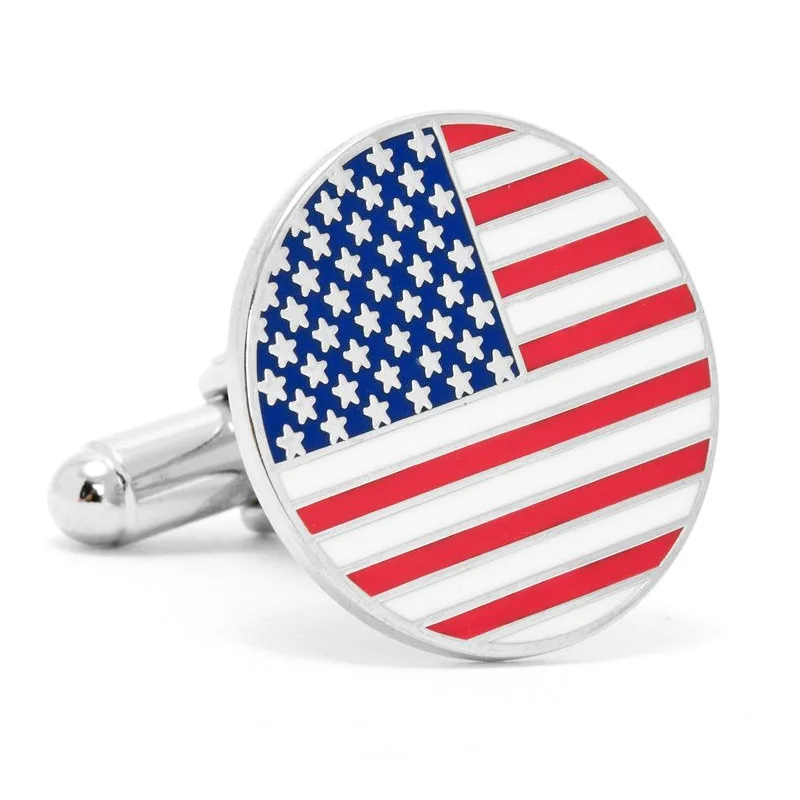
We make custom lapel pins for organizations that fly a flag as part of who they are: embassies and consulates, chambers of commerce, sister-city programs, veterans’ associations, schools, municipalities and companies with a strong home identity. A flag pin is not a logo on a circle: the flag has its own proportions, colour references and, in a two-flag layout, its own order of precedence. We check those before we cut a die.
· Proportion checked against the official reference before tooling
· Pantone 193C red and 281C blue recorded for reorders
· Single, dual, crossed and flag-plus-wordmark layouts
· 12-hour quote, 24-hour artwork, 15-18 day bulk after approval
1. What Counts as a Flag or Patriotic Lapel Pin
Most enquiries we receive fall into five groups. Sorting the project into one of them early decides the die, the colour count and the quantity, so it is worth doing before artwork starts.
|
Category |
Examples |
What we produce |
What we will not do |
|---|---|---|---|
|
National flag |
United States, Canada, Mexico, EU member states |
Single, dual or crossed pins to the flag’s own proportions |
Alter a national flag’s proportions to fit a shape |
|
State, provincial or regional flag |
U.S. state flags, Canadian provinces |
The same layouts, from your official reference |
Invent a version where references conflict |
|
Organizational flag |
Club, school, union, regimental association |
The flag as supplied, with or without a wordmark |
Reproduce a protected emblem without authorization |
|
Patriotic symbol |
Star, stripe, eagle, shield, liberty bell |
Custom artwork, enamel or metal-only |
Present a symbol as an official government mark |
|
Dual or crossed flags |
Sister cities, trade delegations, bilateral events |
Protocol layout with equal flag sizes |
Decide protocol on your behalf |
A note on scope: we make lapel-sized pins. Police, fire, military and other uniform identity badges — the larger shield and crest pieces — belong to our custom badges line, and the two are quoted differently.
2. Flag Proportions Checked Before Artwork
A flag pin that is “close” reads wrong to the people who care most about it. A veteran, a consular officer or a club historian will notice a misplaced star field before they notice the plating. So the first review is arithmetic, not aesthetics.
For the United States flag, the reference proportions are fixed: the flag is 1:1.9 (hoist to fly), the canton is 7/13 of the hoist high and 0.76 of the hoist wide, each stripe is 1/13 of the hoist, and each star is 0.0616 of the hoist in diameter. Other countries publish their own specifications, and some differ from the U.S. in ways that matter at pin scale.
The Six Things We Measure
|
Check |
Reference |
What goes wrong when it is skipped |
|---|---|---|
|
Overall ratio |
1:1.9 for the U.S. flag |
The flag looks stretched or squashed, even at 1 inch |
|
Canton height |
7/13 of the hoist |
Stars sit too high or too low against the stripes |
|
Canton width |
0.76 of the hoist |
The star field crowds the fly end |
|
Stripe width |
1/13 of the hoist |
A 12- or 14-stripe flag reads wrong at a glance |
|
Star field |
9 offset rows, 50 stars |
“50 stars” becomes a decorative texture |
|
Red and blue |
Pantone 193C and 281C |
Red drifts orange; blue drifts toward navy or purple |
Which Version of the Flag
Flags change. A 48-star historical pin, a current 50-star pin and a state flag adopted in a recent year are three different drawings. We work from the version you specify and mark it on the approval drawing, so a reorder does not quietly move to a different edition.
We do not redraw a national flag for visual convenience. If your reference and ours disagree, we stop and ask rather than choose.
When the Shape Must Change
Sometimes the pin is not a rectangle: a shield, a circle, a state outline or a waving form. In that case we change the shape, not the flag. The flag is scaled to fit the available area and the crop is shown on the proof. If the crop would cut the canton or remove stripes, we say so before tooling. If the pin has to follow a contour, the route is the same one we use for custom shaped pins.
3. Fifty Stars at One Inch: What a Flag Pin Can Hold
The star field is where a flag pin stops being a drawing and becomes a tooling decision. At one inch the arithmetic is tight, and it is better to know before the die is cut.
Star diameter is 0.0616 of the hoist. On a 1-inch-wide pin the hoist is about 0.53 inch, so each star is about 0.83 mm across. Our minimum raised metal line is 0.2 mm, and the enamel channel beside it needs 0.3 mm for soft enamel or 0.5 mm for imitation hard enamel. A 0.83 mm star with a 0.2 mm outline leaves roughly 0.43 mm of colour inside — enough for soft enamel, below the limit for imitation hard.
The Four Sizes
|
Pin width (fly) |
Star diameter |
Stripe width |
What the metal holds |
Recommended build |
|---|---|---|---|---|
|
0.75 in |
~0.62 mm |
~0.77 mm |
Star field reads as texture, not 50 separate stars |
Printed with epoxy dome, or metal-only die struck |
|
1 in |
~0.83 mm |
~1.03 mm |
Soft enamel possible; imitation hard is at its limit |
Printed for a clean field; soft enamel if the drawing is simplified |
|
1.25 in |
~1.03 mm |
~1.29 mm |
Both enamel types work with a careful drawing |
Soft or imitation hard enamel |
|
1.5 in and up |
~1.24 mm+ |
~1.54 mm+ |
Full star field, crisp edges |
Enamel, die struck with fill, or die cast |
Three Ways to Keep the Field Readable
· Print the field. Offset or UV print has no metal separators, so 50 stars can be reproduced at 1 inch without merging. An epoxy dome protects the surface. The trade-off is that the pin loses the raised metal line many buyers associate with enamel.
· Enlarge the pin. Moving from 1 inch to 1.25 inches raises star diameter from about 0.83 mm to about 1.03 mm — the difference between “possible” and “comfortable”.
· Simplify the separators, not the star count. Keep 50 stars and increase the metal line only where the drawing allows. We show the revised field on the proof so you can see what changed.
We do not recommend reducing the star count to make a small pin easier. It changes the flag, and the people receiving the pin will know.
Why Stripes Are the Easier Half
At one inch each stripe is about 1.03 mm, which leaves a workable channel after the metal lines. The stripe count is rarely the constraint; the star field is. That is why a 1-inch flag pin can look convincing from across a room and fall apart at reading distance — and why we ask for the artwork before quoting the route.
4. Single, Dual and Crossed Flag Pins: Layout and Protocol
The layout is half protocol and half space. A dual-flag pin on a 1-inch surface gives each flag about 0.45 inch, which is tight for two star fields. Most bilateral programs are better at 1.25 inches or with one flag and a wordmark.
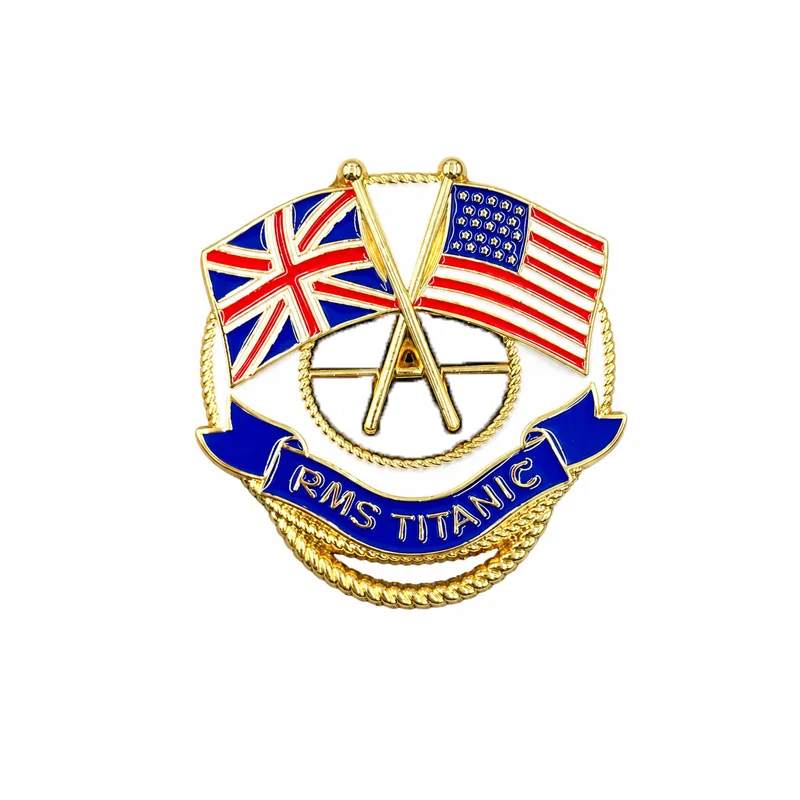
Crossed flags in the lower third, equal size, host pole in front: a commemorative layout on a printed backing card.
The Six Layouts
|
Layout |
Protocol or convention |
Space |
Best for |
|---|---|---|---|
|
Single flag |
Fly to the right when worn on the left lapel |
0.75 in+ |
National day, single-country program |
|
Side by side |
Host nation on the viewer’s left, guest on the right, equal size |
1.25 in+ |
Bilateral events, sister cities |
|
Stacked |
Host nation above, guest below, equal size |
1 in+ (tall) |
Narrow lapel space |
|
Crossed |
Host flagpole in front, equal size, poles crossing in the lower third |
1.25 in+ |
Veterans’ and alliance programs |
|
Flag plus wordmark |
Flag occupies 50-60% of the width, text to the right |
1.25 in+ |
Organizational identity |
|
Flag inside a shape |
Shape must not crop the canton or stripes |
1.25 in+ |
Commemorative and award pieces |
Protocol details vary by country and organization. The convention above is the common one for bilateral civilian programs; when your protocol office specifies something different, we follow your reference. We do not make protocol decisions for you.
Left and Right Lapel Versions
A flag should read the same way to the viewer whichever lapel it sits on. That is why left-lapel and right-lapel versions exist as separate products: the flag orientation is set so the canton stays at the hoist and the fly moves forward, instead of appearing reversed in photographs or in a mirror.
We confirm orientation on the proof rather than assume it. If your program issues pins to both men and women, or to a uniform where the pin sits on the right, tell us at enquiry stage; the two versions are not interchangeable.
Stacked, Crossed and Three Flags
For a stacked layout the host flag goes above the guest flag. For a crossed layout the two poles cross in the lower third, and the host flag’s pole sits in front; both flags stay equal in size. At 1 inch a crossed layout leaves very little room for a star field, which is why we usually steer it to 1.25 inches or larger.
Three flags or more are usually better as a row of smaller flags or as one primary flag with two secondary flags, rather than a crossed arrangement. Send the protocol reference and we will lay it out on the proof.
5. Stock Flag Blank or Custom Die: Which One You Need
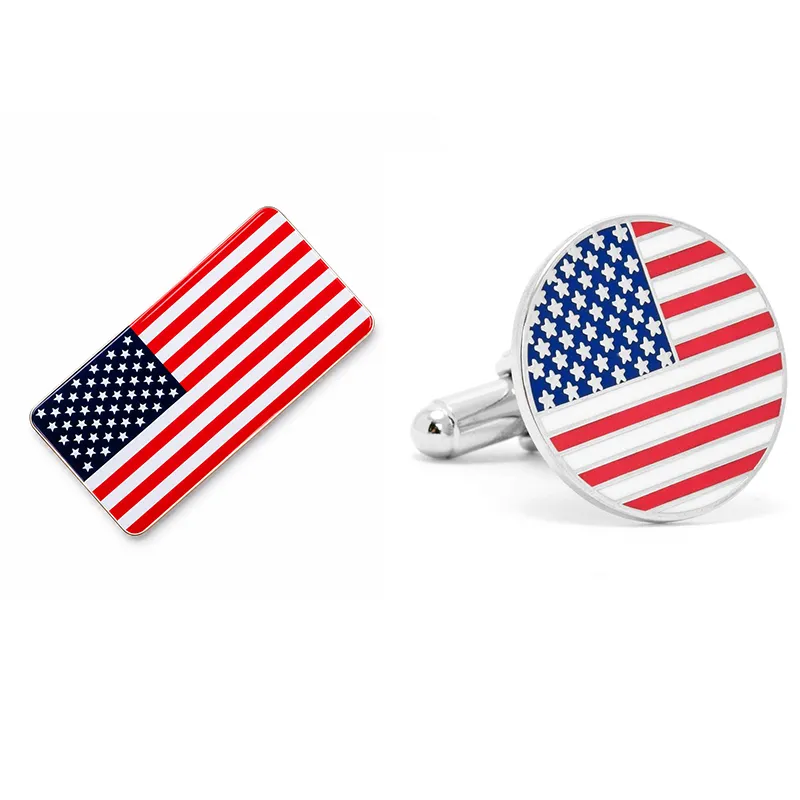
A stock flag blank is a pre-molded waving flag with a small plate for your logo. It is a good product, and it is often the right one. A custom die is a different purchase: it gives you the flag itself, not just a plate beside it.
The honest question is not which is cheaper. It is how much of the flag you need to control.
What a Stock Blank Can Do
A blank gives you a waving flag shape, a fixed flag artwork and a small area for a logo or text. There is no flag die to pay for, the lead time is short, and the unit price is usually lower because the tooling is shared across many orders.
It works when the flag is the backdrop and your logo is the message: a school seal on a US flag pin, a company mark on a state flag, a giveaway for a single event. It stops working when the flag itself has to be a specific version, a specific proportion or a specific pair.
What a Custom Die Adds
A custom die lets us control the flag’s proportions, the stripe and star field, the pairing and the finish. You can change the flag between runs, put two flags into one die at equal size, or match a colour reference across a multi-country program.
You also pay for the die once, and you own the resulting artwork for the life of the tool. That is the trade: a fixed cost now, in exchange for control over what the pin actually is.
The Decision Table
|
Question |
Stock blank |
Custom die |
|---|---|---|
|
Does the flag need a specific version or proportion? |
No — artwork is fixed |
Yes |
|
How much logo area do you need? |
One plate, limited |
The full face |
|
Is there a tooling cost? |
None |
One die per design |
|
What is the minimum? |
Often 50 or fewer |
100 per design |
|
How fast? |
Days |
7-10 days sample, 15-18 days bulk |
|
Best for |
Event giveaway, logo-first |
Ceremonial, protocol, multi-country |
If you need one pin for an event, a retail supplier will be faster and cheaper than we are. If the flag is the point — the right version, the right proportion, the right pairing — the die is what buys you the right to change it. We will tell you which side of that line your project sits on before you commit.
6. Choosing the Build for Custom Flag Lapel Pins
Once the proportion and the size are settled, the build is a routing decision. Each of these is a real production route, not a marketing tier. The detail pages carry the process parameters; this table only tells you which route suits which flag.
|
Build |
How the flag is made |
Best when |
Detail |
|---|---|---|---|
|
Soft enamel |
Colour sits below raised metal lines |
Bold flags and stripes at 1.25 inch and up |
|
|
Imitation hard enamel |
Colour polished flush with the metal |
A smooth formal surface for ceremonial wear |
|
|
Die struck, no fill |
Metal only; plating and recess create the contrast |
Single-colour or two-tone metallic emblems |
|
|
Die struck with soft enamel fill |
Metal outline, colour in the recess |
Crisp metal separators between flag colours |
|
|
Offset or UV print with epoxy |
Full colour, no metal separators |
Dense star fields, multi-colour flags, fine detail |
|
|
Die cast 3D |
Curved, sculpted waving flag |
A waving flag with real curvature |
|
|
Custom outline |
The pin is cut to the flag or emblem shape |
State outlines, shields, waving silhouettes |
For most national flag pins at 1.25 inches, soft or imitation hard enamel is the right default. For anything at 1 inch with a full star field, printed is usually the better answer, and we will say so even though enamel is the more familiar product.
7. One Die, Many Countries: Multi-Flag Pin Programs
A chamber of commerce with twelve member countries, an embassy running a cultural series, or a distributor serving several markets will ask the same question: do we need twelve molds?
Not always. There are five workable structures, and they differ mainly in how many dies you pay for and how much of the flag is fixed.
|
Structure |
Dies |
What changes per country |
Best for |
|---|---|---|---|
|
One die per country |
1 per country |
Everything |
3-6 countries with solid volume each |
|
One die plus printed insert |
1 shared die + print plate |
The printed flag panel |
6-30 countries, embassy and association programs |
|
One die plus enamel colour bands |
1 shared die |
One or two enamel colours |
Flags that share a simple structure |
|
Stock waving blank plus logo plate |
No custom flag die |
The logo plate |
Fast turnaround where the logo matters more than the flag |
|
One die plus year or edition tag |
1 die |
A tag, ribbon or year mark |
Annual events in the same country |
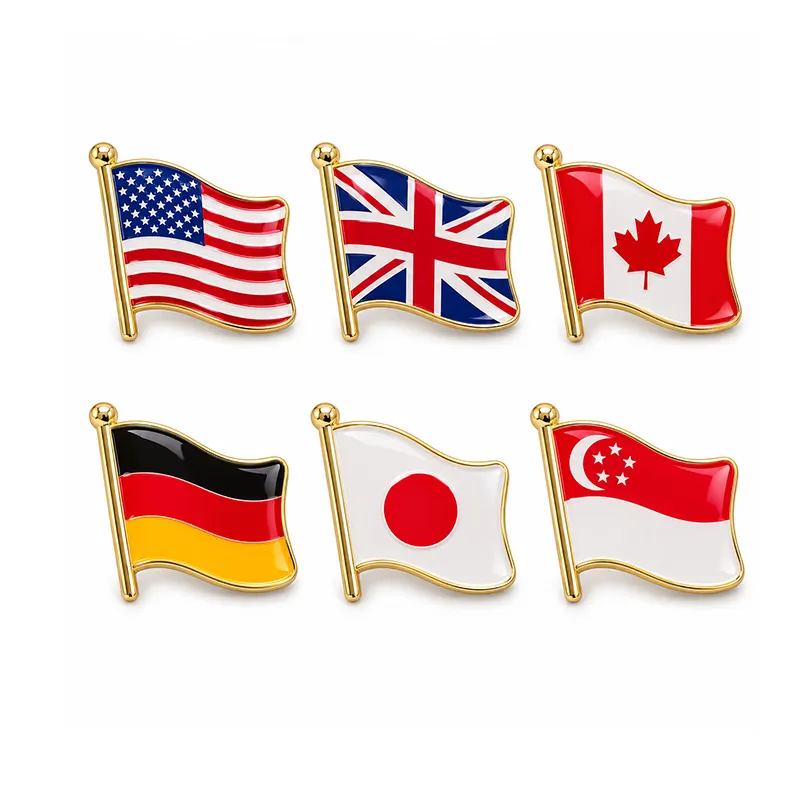
Twelve countries at 100 pieces is 1,200 pins, but it is also twelve designs and twelve dies if each flag gets its own tool. The same 1,200 pins can be produced from one die with twelve printed panels, which changes both the tooling cost and the minimum quantity per country.
We quote both structures when a program involves more than a handful of countries, so the comparison is visible rather than implied. If the printed-panel route cannot hold the detail your flags need, we say that and fall back to separate dies.
8. Flag Color Control Across Reorders
Flag colours are a reference, not a preference. The U.S. flag is commonly specified as Pantone 193C for red and 281C for blue. Other countries publish their own references, and some organizations maintain a house version.
We match to the reference you provide, then record four things on the job file:
· the Pantone reference used for each colour
· the enamel batch and the plating
· the die number and the metal line width
· the date of the approved proof
Those four fields are what make a reorder repeatable two years later. Without them, the next run is a fresh interpretation, and the red drifts.
Plating changes how the pin reads as a whole. A gold border warms the overall impression; a silver border cools it; antique finishes mute both. The enamel itself does not change colour with plating, but the frame around it does, and that is what people see at arm’s length.
Molds are kept for three years, and the tooling fee is refunded once cumulative volume for that design reaches 10,000 pieces. Every run is checked before packing under our pre-shipment inspection process.
9. Backing and Presentation for Ceremonial Flag Pins
A flag pin is often worn on a suit, a blazer or a uniform, and the backing matters more there than on a lanyard.
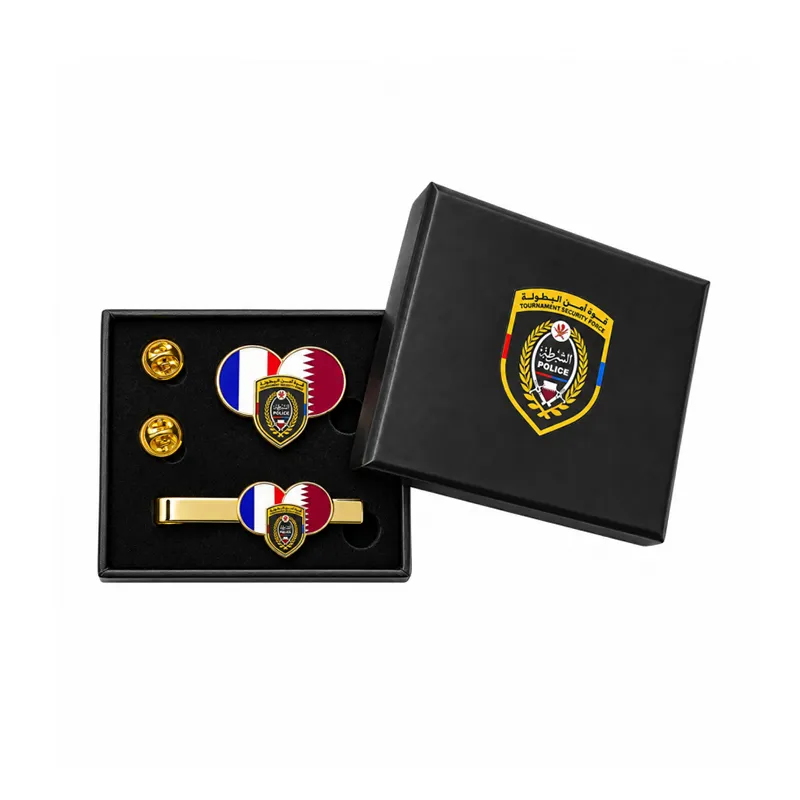
A waving flag in soft enamel, mounted on a printed card that carries the event name.
|
Backing |
How it holds |
Best for |
|---|---|---|
|
Butterfly clutch (11 mm standard) |
Firm, familiar |
Most pins |
|
Rubber clutch |
Softer grip |
Lightweight pins on thin fabric |
|
Magnet |
No hole in the fabric |
Silk, suits, ceremonial dress |
|
Safety pin |
Hangs from the fabric |
Sashes and ribbons |
|
Screw nut |
Very secure |
High-value presentation pins |
For formal wear, the magnet is the considerate choice: it does not put a hole in a silk lapel. Above 1.25 inches we specify a stronger magnet and confirm the hold with the sample rather than assume it.
For a delegation gift, a box carries more weight than a poly bag, and a printed backing card lets the recipient keep the event details with the pin. We supply poly bags, backing cards and gift boxes; the packaging options page covers the formats.
10. What to Send for a Custom Flag Pin Quote
A flag quote moves fastest when the reference is unambiguous. These nine items are enough for us to price the project and flag any manufacturing risk:
· 1. Which flag, and which version (for example, the current 50-star U.S. flag or a historical edition)
· 2. Vector artwork, or a link to the official specification
· 3. Pin size, measured across the longest edge
· 4. Layout: single, side by side, stacked, crossed or flag plus wordmark
· 5. Quantity per design, not just the total
· 6. Plating preference: shiny gold, shiny silver, antique gold, antique silver, black nickel
· 7. Backing: butterfly, rubber, magnet, safety pin or screw nut
· 8. Packaging: poly bag, backing card or gift box
· 9. The date the pins must be in hand
One more item is a condition rather than a specification: you confirm that you have the right to use the flag, seal or emblem you send us. National flags are normally straightforward; government seals, military branch insignia and police or fire service marks require written authorization from the organization that owns them. We ask before tooling, not after.
Our artwork review is free, and the first drawing is returned within 24 hours.
SEND YOUR FLAG REFERENCE
Have a flag reference?
Send the flag, the version, the size and the quantity per design. We return a written spec and quote within 12 hours, and an artwork review within 24.
11. What Drives the Cost of Custom Flag Pins
We do not publish a per-piece price for flag pins, because the same 1-inch pin can be three different products. These are the variables that move the number:
· Size — priced on the longest edge; a 1.25-inch pin is not 25% more metal than a 1-inch pin, but it is a different die
· Number of colours — each enamel colour is a fill step
· Build — print, soft enamel, imitation hard enamel, die struck and die cast sit at different cost levels
· Plating — antique and special finishes cost more than shiny gold or silver
· Number of dies — the single largest variable in a multi-country program
· Backing — a magnet costs more than a butterfly clutch
· Packaging — a printed card or gift box adds a step
· Quantity per design — 100 pieces of one design is a different run from 100 pieces across four designs
As a rule of thumb, moving a full star field from enamel to print reduces risk at 1 inch and often reduces cost at the same time. Moving from a single die to twelve dies is what changes a program budget, not the plating.
12. Frequently Asked Questions About Flag and Patriotic Lapel Pins
13. Start Your Flag Pin Project
Send the flag, the version, the size, the layout and the quantity per design. If you have a protocol reference, send that too. We return a written specification and quote within 12 hours, artwork within 24 hours, samples in 7-10 days and bulk in 15-18 days after approval.